Wednesday, August 9, 2023

THE SHADOW: DESTINATION MOON Chapter 6

6
(You can read the previous chapter HERE.)
The car was parked in the shadow of the trees not far from the gate of the mansion. It was long and black and had a Federal Government license plate. A silent driver sat behind the wheel. The rear seat was empty. Out of sight of the gate and the mansion, hidden among the trees, two men were deep in secret conversation.

They had slipped from the car unseen by anyone but Shrevvie.

Both men wore civilian clothes, but both had distinct military bearing.

They were watching the high wall and the gate of the mansion, obviously considering some plan. Suddenly the taller of the two hidden men touched his companion and they both froze in the shadows. The headlights of another car were approaching. The lights suddenly went out but the car came on slowly in the night. This new car stopped out of sight of the gate. It was a New York city taxicab. A man got out. The two men saw the man. They stood up where they were hidden among the trees. The man walked to them from the taxi. It was Lamont Cranston. He stood with the two men, hidden among the trees in the silent night.
Cranston spoke to the taller of the two men. “What brings you out here, General Rogers?”
“Keep it down, Cranston,” the tall General snapped. “I want them to see the car, but not us yet. And I was about to ask you the same question.”

It was obvious that the tall Brigadier General and special aide to the President was not pleased to see Cranston.

“I have business with Secretary Misygyn,” Cranston said simply. He turned to the second man, the lantern-jawed Major John Oates of the CIA. “I gather you two also have some business with our Russian friends?”

Major Oates was curt. “I don’t think we can discuss the matter with you, Cranston. I suggest you leave your business until later. Unless you would care to tell us what business a supplier for Project Full Moon has with the Soviet Mission?”

“Yes, Cranston,” General Rogers said. “Just what business do you have with the Russians?”
Cranston hesitated, or seemed to hesitate. Behind his calm, hooded eyes he was playing the role of the reluctant participant. Actually, he was studying Rogers and Oates. What were they doing out here? How much of all this did they know? Cranston went on with his act. He looked around, and then he reached into his coat pocket and produced a small envelope. He handed it to General Rogers.

“That will explain,” Cranston said. “Commissioner Weston spoke to General Broyard, and to the President, and they agreed to let me work on the matter. I have a rather large international organization in my companies, and I can get information. It is important to me that we locate the trouble with Project Full Moon. I think an unknown civilian force might be able to obtain details the official agencies cannot.”

Rogers handed the authorization paper to Major Oates. The lantern-jawed CIA man studied it with obvious distaste. But the signatures were official and irrefutable. Oates handed the papers back to Cranston.

“Amateurs! What else are they going to do to tie my hands,” Major Oates said bitterly.
Cranston smiled. “Not quite an amateur, Major. I have had considerable experience with Commissioner Weston. I think you may need all the help you can get, and my companies are widespread. For example, I gather you are both here for some real purpose, and it would not surprise me if it was connected to my purpose for being here—if the two purposes are not identical. So, you see, I may not be so useless, Major.”

“Just what is your purpose, Cranston.” General Rogers said warily.
“A small suspicion about Federal Cybernetics,” the wealthy socialite said quietly. “Since General Broyard and Commissioner Weston instructed me to work on the matter, I have had my company personnel watching the various other suppliers of the Full Moon Project. At Federal Cybernetics they discovered a woman scientist in the General Laboratory who was not all she was supposed to be. Her name is Dr. Freda Talent. She has been acting oddly, and a check on her past reveals that she is not known at some of the references she gave to get her position! Then, just tonight, my men observed her leaving the laboratory with some strange men and another senior scientist at the lab. She seemed reluctant to go with these men. In fact, she acted as if she were being abducted. So my people followed and alerted me. Here I am.”

There was a silence in the night on the road in front of the wall as Oates and Rogers looked at each other. Cranston watched them carefully from behind his impassive eyes. He had told the story of the disguised Margo to throw them off in case they too were suspicious of her, also to make himself look detached and alert if they knew about Dr. Freda Talent. He wanted to divert them from considering any possible connection between Margo and himself—or The Shadow.

The work and identity of The Shadow had to be protected at all costs. Only in anonymity could the black Avenger do his work of justice. But Rogers and Oates seemed to have no suspicions.
General Rogers nodded at last to the CIA Major.
“Tell him what we have learned, Major,” Rogers said.
Oates was still reluctant, but he told. “We had a report from our undercover people at Federal about one of the senior scientists. I have had my eye on this man, Otto Reigen, for some time. He is a defector from the USSR many years ago. We’ve never been sure of him. But until recently he gave us no cause for real suspicion. Now he has. I think he is a Soviet agent—a long-term plant.
We figure he was sent here to be used in some extreme emergency, and laid low and clean all this time. He began to act strange about a month ago, made contacts with a known Soviet courier. We even traced him to a man we think is a top agent. Maybe even Colonel Derian himself, we can’t be sure.”

Cranston’s hooded eyes showed nothing. He listened as if the name of Colonel Derian meant no more to him than the name of a total stranger. From his face no one could have guessed that only minutes earlier he had been watching Colonel Derian himself. Oates saw nothing, but the eyes of the taciturn Major almost glowed when he mentioned Derian.

“We’ve been after Colonel Derian a long, long time. He’s the best and coldest counter-agent I ever ran into. Even his own spies fear him. If we could just get Derian out of all this it would be worthwhile,” Oates said.

“I think that Project Full Moon’s success is a bit more vital, Major,” Cranston said.

“Yes,” General Rogers agreed. “Go on with what we know, Major.”
Rogers nodded. “Well, when we realized that Reigen could be a Soviet agent after all, it seemed likely that he is the key to the sabotage of Full Moon. Then tonight we saw him leave with the woman. She was clearly reluctant to go, so our man followed also. He reported to us.”

General Rogers took it up. “I discussed the matter with the President, and he agreed that it is all very delicate. If Reigen has been tampering, or simply spying, we need strong proof before we act. To merely stop Reigen would be useless, they would only replace him. Also, time is a factor—we must get Full Moon off the ground soon. Off the record, Cranston, our own espionage in Russia convinces us that the Soviet space people are also farther ahead than weexpected! So we have a choice: we can continue undercover and attempt to expose and smash the sabotage effort; or we can come out into the open and let the Soviet know that we know of their activities and that way make them stop. Since the matter is not a military one, we think that this will work. We tell them what we know, and warn them to call it off or be exposed. I think they will not want to lose face in the eyes of the world, and will cease their activities rather than be exposed to the ridicule of spying on a civilian project we are all supposed to be neutral about.

After all, both sides have said that the Moon should be a cooperative venture.”
Cranston half smiled. “A cooperative venture in which both sides, us and them, are frantically trying to be first!”

General Rogers shrugged. “Be that as it may, Cranston, we have our immediate problem.
Oates prefers the undercover approach, as he would. It is more important to Oates to catch spies than to prevent them spying.”

Cranston smiled at Oates. “The professional mind, Major? The form not the substance, eh?
Catch the spy even if it wrecks your project.”

Oates bristled. “Catching spies is my job. If you don’t catch them today, they spy on something else tomorrow. Sometimes we have to sacrifice a project to save future projects.”
Cranston nodded. “A good statement of the bureaucratic mind. However, I gather that the President and General Broyard disagree this time, as I do, or General Rogers would not be here.”

“Right,” Rogers said. “We decided to wait until Reigen contacted known Soviet officials.
Tonight he has done so with the abducted woman, if she was abducted. It could be just an act.

She could be in with them. You said yourself, Cranston, that she has been acting strangely.”
“She has,” Cranston said.

“So,” Rogers said. “We are here for two purposes. Oates will observe and see what he can detect. I will make an official call and let Misygyn know that we are on to him.”
Cranston frowned in the night. “One thing bothers me, General, and that is the woman. If she was taken by force, then they may be alert and reluctant to show us anything. I think that with her in their hands they are exposed. If we just walk in they will cover up, and neither Oates nor I will see anything. It is, after all, technically Soviet territory we invade. They can refuse Oates and myself entry.”

“What bothers me is giving them warning!” Oates said. “We should try to catch them cold, catch them in the act! That way we might even get Colonel Derian!”

Rogers was angry, his voice almost hissed low in the night. “We are not interested in getting them! We are interested in stopping them. We must get off the next shot and land our men on the Moon. If we can stop them long enough for that one shot, it will be all settled, and we won’t have to get them—they’ll quit!”

“Perhaps,” Cranston said quietly, “We can do a little of both.”
The two men looked at the wealthy socialite.
“What?” Rogers said.
“What’s on your mind, Cranston?” Oates said.
Cranston was thoughtful. “Just this. If we are right, and they have abducted this woman, they are vulnerable. A little careful observation in secret might show us some clues. At least, it is a chance and better than either speculating or walking in and letting them see all of us and cover up. On the other hand, since this is an essentially non-military matter, letting them know that we are aware of their sabotage, and will inform the world of it, might just be enough to make them desist and prevent any more sabotage.”

“How do we do both?” Oates snapped.
“By sending General Rogers in on an open official visit,” Cranston said, “and by you and I going in under cover and seeing what we can locate while General Rogers keeps them busy! Of course, we would have to go in first. We might see quite a lot. They are undoubtedly aware by now that the official car is here, but they don’t know how many of us there are. If the General makes an official visit, with his driver, they might very well let down their guard.”

Rogers and Oates said nothing. The two military men in their civilian clothes stood hidden in the shadows and seemed to be considering the proposal from all angles. Cranston waited—he had not, of course, mentioned his major reason for the plan. That was to have time for The Shadow to free Margo without the two men being aware of the connection between Cranston and the black-garbed Avenger. At last Oates spoke.
“I suppose it’s better than nothing, given that we want to do both things.”
Rogers agreed. “Yes, it’s not bad. The primary object is to try to prevent any further sabotage, and I think we have the best chance with Cranston’s plan. But I must be sure they do not get wind of any trick. I think Cranston is right that you two should go in first. Oates can get to the front of the house, inside if possible, and Cranston can go to the rear. There will probably be guards, so you’ll have to be careful. I’ll give you ten minutes to get into position before I make my official call.”

The plan was just what Cranston wanted. The socialite nodded his agreement. “Good. Then I suggest we get started.”

As he prepared to go over the wall again, Cranston did not tell them that he knew that there were no guards, and that the dogs were still under the power of The Shadow. He knew that there would be no trouble getting to the house. After that, The Shadow would take charge!

“Synchronize our watches.” Oates said.
The three men set their watches in unison. General Rogers nodded to Oates and Cranston.
“Ten minutes then. After that I make my official call,” Rogers said.
The two men nodded. They vanished into the night in opposite directions.

In the broad parklike grounds of the Soviet mansion again nothing seemed to move. The dogs were silent. No guards walked the grounds. Nothing moved until, behind the house, part of the night itself seemed to detach and float across the open space to the window of the office that was open. The fiery eyes of The Shadow appeared again at the open window.
Inside the dim office still lighted only by the single light on the desk of Misygyn, the official himself, Vaslov and Colonel Derian were talking. There was no sign of Margo or the two armed men. Misygyn seemed very uneasy. Vaslov seemed afraid. Only Colonel Derian was in full control of himself.

“What is going on at the gate, eh?” Derian said in Russian.
Misygyn shrugged. “I don’t know, Colonel. The car is there, that is all the electronic scanner shows. Perhaps our potential visitor is deciding on his course of action. It is an unusual hour for an official call. Perhaps our caller is re-evaluating his position.”

“Who could it be?” Vaslov asked nervously.
“Probably someone looking for information,” Derian said. “Whoever it may be, Misygyn, get rid of him fast. We have much work to do on Dr. Talent. I am anxious to get to it. Until the visitor goes I will keep her under guard in the room downstairs. After that I wish to be alone with her, is that clear?”

Misygyn showed distaste on his face. “Do not tell me the details of your work, Derian. I would rather not know. I will help you as much as necessary, but I will not participate. Is that clear?”

Colonel Derian smiled his cobra smile. “Quite clear, my dear Excellency. You have no compunctions about using my results, but you are squeamish about how they are obtained! Ah, what has happened to the men of the Revolution? Where are the men who broke the eggs to make Lenin’s omlette? We grow soft, Misygyn, much too soft. Down in my room, alone, there is no softness!”

Outside the window the glowing eyes of The Shadow watched the snake-like Colonel.

Inside him the hatred swelled for this man with the eyes and the soul of a cobra. But Derian had told The Shadow the one thing he had to know—Margo was down in the secret room directly beneath the office! While Rogers was in the office, Margo would be guarded only by the two armed men.

Colonel Derian and Vaslov would not be in the secret room, they would probably be in the next room to the office listening. It was all that The Shadow needed—to have them all separate and unaware of the danger from The Shadow.

The intercom on Misygyn’s desk suddenly buzzed in the silence of the office. Vaslov jumped a foot. Colonel Derian sneered at the scientist. Misygyn flicked the button on his intercom.
“Yes?” Misygyn said, and listened. The two other men waited.
“General Ropers?” Misygyn said, and the diplomat looked hard at the other two. “Send him in.”
Misygyn clicked off his intercom and sat back. “Brigadier General Calvin Rogers. I know him well. A special assistant to the United States President. What do you make of it Derian?”

“They are worried about Project Full Moon, of course,” the Colonel said. “I imagine he is going to pump you. They must have learned of our accelerated schedule. Leave your intercom key open, Misygyn. We will listen in the next room. Come, Vaslov.”

The tall Colonel led the small scientist from the office just as the outer door opened. Calvin Rogers entered the room. The General looked around, but there was no evidence now of anyone else having been with Misygyn. The diplomat stood and smiled at Rogers as he extended his hand. The two men shook hands, and Misygyn waved Rogers to a seat. Rogers sat down.

“What can I do for you, General?” Misygyn asked smoothly. “You call at an odd hour.”
“It is a matter that has no normal hours, Excellency,” Rogers said grimly.
“Ah?” Misygyn said. “That important? Surely you could have conducted it through the normal channels? My Government does not approve of, how do you say, personal diplomacy?
We leave such old-fashioned methods to our British and French friends.”
“I don’t think your Government would appreciate this matter going through the normal channels. Those channels have many leaks. I think your Government would want this kept quiet, Misygyn.”

“So?” the Russian diplomat said. “What would we want kept so quiet, my dear General?
Surely you know that my Government has no secrets from the world?”

“I won’t bother to laugh at that one, Excellency,” Ropers said drily, “but I will repeat that we think that you would not want it broadcast around the world that, after all your pious pleas for peaceful cooperation in space, you are sabotaging our peaceful efforts to reach the Moon.”

Misygyn jumped to his feet. “You dare to accuse the Government of The Union of Soviet Socialist Republics of sabotage!? A direct accusation that we are sabotaging Full Moon? You will please leave my office at… .”

Rogers smiled. “How did you know that I referred to Project Full Moon? How did you even know about Full Moon? It is a top secret project, as you must know, and not our regular Moon Project. How did you know about Full Moon, Excellency?”

Misygyn slowly sat down, smiled. “Ah, yes, a slip of the tongue, eh? All right, General, we are aware of Project Full Moon. We have our sources of information, as you know. But we are not sabotaging! In fact, since you bring it up, our major interest is what you… .”

The two quick shots echoed like blows in the dark night! Misygyn froze.

General Rogers jumped up and half-turned toward the door.

The Shadow, at the window, had listened to the conversation, and had been just about to begin his task of freeing Margo. He was already studying the darkened windows on the other side of the mansion.

When the two shots ripped the silent night The Shadow’s burning eyes watched the reaction in the office of the Russians. Margo must be freed—if the shots had not been her death blow!
To Be Continued
MONDAY
at
Please Support Crime & Punishment
Visit Amazon and Buy...
by James Patterson and Brian Sitts

Wednesday, August 2, 2023

THE SHADOW: DESTINATION MOON Chapter 3


3
(You can read the previous chapter HERE!)
The buildings and central laboratory of Federal Cybernetics, Inc. were located on the outskirts of New York City near the town of Hempstead. It was a complex of four low buildings, all one-story except the main office building which had two stories, set in the center of a wide and neat parklike grounds with a well-kept expanse of green lawn and many trees and shrubs. A high cyclone fence surrounded the grounds, nothing on the building identified it, and there were guards on the single gate in the fence. Unknown to anyone but the Security people and the President of the company, there was a complex and efficient electronic security system that included alarms, scanners to detect any objects going in or out of the plant or lab, coded detectors to authenticate all badges worn by personnel or visitors, and a complete computer file of the full labor force.
On an evening two days after the fourth failure of the Full Moon Project rocket launch, the production areas were working at top capacity on the complicated electronic equipment made by the company. The research laboratory staff was as busy as ever on the future projects of the company. In the main research laboratory the company’s Chief of Research, Dr. Max Ernest, sat alone completing his progress report for the work of the day. The office of the Research Chief was a glassed-in cubicle set in the corner of the laboratory farthest from the entrance. Two closet doors were in the wall, both locked for classified material. There was a small but strong safe behind Ernest’s desk. The Doctor was working with great concentration as the day became evening and the work slowed to a halt. Ernest did not hear the approach of his employer until he opened the door of the glassed cubicle. Then Ernest looked up, saw his boss, and leaped to his feet to help.
“Don’t jump up like a jack-in-the-box all the time, Max!”
Dr. Ernest reddened. “Sorry, Mr. Bryan. I just… .”
“I know what you just,” J. Wesley Bryan snapped testily. “But I can maneuver perfectly well as I’ve tried to impress on you.”
J. Wesley Bryan, President and sole owner of Federal Cybernetics, Inc., was a small, sharp-faced man who sat and moved in a wheel chair. Impeccably dressed in a simple business suit, Bryan looked like a grey mouse in his motorized chair. There were no outward signs of the injuries that confined him to the chair, and his sharp black eyes snapped with a very un-mouselike fire. He maneuvered his chair, as he had said, with amazing agility, helped by the complex electronic controls of his own design. Now he wheeled to the desk where Dr. Max Ernest had sat down again. Bryan glanced at the report Ernest was working on, and then his piercing eyes looked at the Research Chief.
“Has the shipment gone?”
Ernest nodded. “Yes, two hours ago.”
“Good,” Bryan said. The tiny man rubbed his thin hands together. “So, we are almost at the end, or should I say the beginning? Yes, the beginning by all means.” Bryan’s black eyes snapped at Ernest. “You heard about the failure at Full Moon again? Do they have anything to report?”
“I’m expecting Farina any minute. I imagine he’ll give the details if he has any,” Dr. Ernest said.
“So? He comes here? Perhaps they have found something wrong in the fuel control after all?”
Bryan said, a certain look of worry on his face now.
Ernest shook his head. “Impossible. The control is perfect. They made every possible test that we did not.”
“You are sure?”
“Of course!” Ernest said.
Bryan watched his Research Chief. “Perhaps, but I think I will do some work myself. I’d rather not see Farina anyway. The key?”
Dr. Ernest got up and walked to the small but powerful safe. He worked the combination dial.
The safe opened and the Research Chief took out a key. He handed it to Bryan and closed the safe. Bryan took the key and wheeled to one of the doors clearly labeled: Storage. The President of Federal Cybernetics took a second key from his pocket. With each key he unlocked part of the same lock—inserting each key in turn into the same keyhole. He replaced both keys in his waistcoat pocket and swung open the door. He wheeled in and the door closed behind him.
When the door had been open anyone who had seen the interior would have seen—a closet with shelves of papers and bottles!
Dr. Max Ernest returned to his desk and went on with his report. Some ten minutes later, less than a half an hour before five o’clock, the intercom buzzed on Ernest’s desk. The Research Director flipped his speak switch.
“Yes?”
“Professor Stanley Farina to see you sir,” a female voice announced.
“Send him in,” Ernest said.
The Research Director leaned back in his chair and waited. A smile wreathed his face as the small, stocky rocket expert from the NASA Utah Base entered his office. Farina smiled in return.
The two men shook hands cordially. Ernest waved Farina to a chair in front of the desk and offered the rocket man a cigar. Farina declined. After his initial smile, Farina’s face had set in a deep and worried frown. He looked at the Research Chief.
“You heard, Max?”
Ernest nodded. “I heard. The fourth time. I just can’t figure it, Stanley. Is there any chance that it has anything to do with the fuel control?”
“Not that I can determine,” Farina said. “Or anyone else.”
Ernest was thoughtful. “Still, the fuel control is the only really new piece of equipment.
Everything else has always worked well. Mr. Bryan is concerned. He counts a great deal on the fuel control being perfect.”
“We’re checking it out again, Max, but I’m sure its okay. You have all my tests reports. It should work perfectly. All the tests you couldn’t make we did with our full facilities,” Farina said. The small rocket expert frowned again. “It has to be sabotage, Max. I think we all know that now. There is no other explanation. Even Oates and Commissioner Weston have to agree after this failure.”
“You’re sure? I find it hard to think who would sabotage Project Full Moon. After all, it’s not a military project. The Soviet, the British, the French, have all cooperated. We’ve even promised them the fuel control if it works out. What can they gain? The United States has already agreed to an ‘open’ Moon. I simply don’t understand. Do you?”
Farina shook his head. “No, I don’t. And no one else does either. A man named Cranston was with us, he’s a trained criminologist, and he can’t understand why we would be sabotaged.”
“Lamont Cranston?” Ernest said. “Of Lamont Cranston Enterprises? He supplies you too, doesn’t he?”
“Yes, two of his companies do,” Farina said. “Do you know him?”
Ernest nodded. “Yes, but only by sight and reputation. He is a powerful man, very clever.”
Farina narrowed his eyes as he watched Dr. Ernest. There was a momentary silence in the glassed-in office. Outside, in the main laboratory, the workers were clearing their benches in preparation for the end of the day. Farina’s voice was low when he spoke again.
“You’re not suggesting that Cranston might be behind the sabotage?”
Max Ernest shook his head. “No, not really. It is impossible to believe; a man of his reputation. Still, he does have a close access to many vital parts.”
“True,” Farina said. “But so do you.”
Ernest smiled. ” Touché, I do indeed. And, I might add, so do you, Stanley.”
Farina sighed. “That’s the trouble—there are a lot of possible suspects, but not one you can really accuse. Besides, no one was near the Base.”
 
“Except Cranston,” Ernest said.
“Yes, except Cranston—who was late to arrive!” Farina said. “I wonder?”
“So do I,” Max Ernest said.
At this moment, unseen by Farina, a small light glowed beneath the desk of Dr. Max Ernest.
Ernest gave no hint of the existence of the small light, or of the fact that he had seen it. Instead he smiled at Farina, and then casually stood up.
“Maybe we had better make one more check of the production line, Stanley. Just to be sure. It will take some hours, but the line will shut down soon, and we can take it step by step. With such delicate work we only work the eight hours with two shifts. Four hours a man is all we dare let them work. After that the margin of error becomes too high.”
Farina nodded wearily. “We better be sure. I’ve got a long session with Oates soon.”
Dr. Ernest led Farina from the glassed-in office and across the now deserted laboratory. They went out into the main hall of the laboratory building. The door closed behind them. For a time there was only silence in the dim laboratory. All the workers had gone, the desks and benches were clean and bare of all but the experiments that could not be stopped. These lengthy experiments went on untended, the solutions and equipment like some mysterious landscape in the darkened laboratory. All was still and silent. Then there was a sound. It came from the empty office of Dr. Ernest.
The door that was so clearly labeled, Storage, now opened and the wheel chair of J. Wesley Bryan came out. The chair, on rubber wheels and with ball-bearings, made almost no sound as it glided across the office. The light under the desk of Dr. Max Ernest had now gone out. Bryan sat in his chair in the silent office for a few moments. His quick black eyes studied the office and the dim laboratory outside through the glass walls. Then he wheeled to the safe and opened it. He took out a large ledger-type book and slowly made an entry. He closed the book and returned it to the safe. Then the small, mouselike man wheeled around and propelled himself out of the office and across the deserted laboratory. He stopped once to closely inspect an experiment that was proceeding automatically on a bench. Bryan studied it, made a small adjustment, nodded with the satisfaction of the scientist who sees an experiment proceeding well, and wheeled himself to the door and out into the corridor.
Again there was silence in the laboratory.
It was some five minutes before anything moved in the laboratory again. A man seemed to rise up from the dim light itself. He came from inside a long laboratory bench and stood up in the 19
dimness. He was a small, dark-haired, wiry man of middle age. He wore the white laboratory coat of a senior research chemist over his business suit. He was, in fact, one of the men Dr.
Ernest had been observing at work in the laboratory some hours earlier. Now he stood motionless for a time, and then he moved quickly and without hesitation across the laboratory and into the glassed-in office of Dr. Ernest. There he looked around for a moment. He walked quickly to the door marked Storage, and stood looking at it. It was clear that he had seen J. Wesley Bryan come out of the door. He studied it for a time, and then tried to open it. The door was locked. The small man rubbed his chin. Then he turned with a nod of his head and went to the small safe. He bent down over it. His fingers worked deftly, his ear close to the dial, and he neither saw nor heard the faint sound out in the laboratory. For a second, if he had looked, he might have seen a flash of white. But he did not look, and the flash of white was gone as soon as it had appeared.
The man sat back, the safe swung open. Crouched on his heels, the man took out the contents of the safe and studied each of them carefully one by one. He put everything back except the ledgerlike book that J. Wesley Bryan had made an entry in. The man opened this ledger and very slowly turned the pages. After a time he began to frown; he leaned over the pages and seemed to study them intently. Then he became suddenly excited. He stared at the open pages of the ledger.

Finally he began to nod, his eyes highly excited. He took a tiny camera from his pocket and began to photograph the pages one by one. Not all the pages, only certain ones. The job completed, the wiry man put the camera back into his pocket, returned all the material to the safe, and closed the safe. He stood up, looked around the office of Ernest again, then walked to the door and out into the main room of the laboratory. He crossed the laboratory, looked all around, and went out the same door as Bryan into the corridor.
For the third time the dim laboratory was silent. Seconds ticked off.
Minutes.
The flash of white appeared again. It came from a door to the left. Not the door into the corridor which was on the right of the laboratory, but the door in the left wall that was simply marked: Women’s Locker Room. The white was another laboratory coat that emerged from the Women’s Locker Room. The coat was worn by an older blonde woman who limped perceptibly as she crossed the laboratory toward the office of Dr. Max Ernest. She was clearly a woman about fifty, not tall, and her face was heavily lined with years of close work bending over experiments in laboratories. She, too, was one of the research personnel of the laboratory. As she limped across the laboratory her quick eyes were alert for any movement, any intrusion. She entered the office of Ernest but did not waste time trying the door of the room marked Storage. It was plain that the woman had been observing the wiry man as he worked in what he thought was an empty laboratory. She went straight to the safe and bent down over it.
She manipulated the dial, again in a manner that proved that she had observed the combination worked out by the small, wiry man. She did not hesitate, nor did she place her ear to the dial to hear the tumblers. She turned the dial like one who knew the combination. The safe opened. She reached in and made a quick study of the contents, and then turned her full attention to the ledgerlike book Bryan had made his entries in, and the wiry man had become so excited about. Some time passed as the woman studied the ledger page by page. From time to time she stopped to read a page more closely. Her lined and middle-aged face showed considerable puzzlement as she read. Once or twice she seemed to stare at something and think hard. She read every page in the book, and when she closed it at last she stood and stared off into the space of the silent laboratory for some minutes. Then she returned the book and all the other material to the safe, closed the safe, and went back out into the main room of the laboratory. As she recrossed the laboratory toward the door of the Women’s Locker Room, she suddenly darted for cover behind a dim bench.
She had heard a sound in the corridor. She crouched out of sight.
The door into the corridor opened. A man in the grey uniform of a company security guard looked into the laboratory. He carried a time clock. He went to the laboratory time station and used the key to mark his time clock. He looked around once more. Then he went back to the door and out into the corridor.
The woman scientist stood up and stared after the guard for a moment. Then she turned quickly and limped to the door into the Women’s Locker Room. Inside the locker room she moved down the rows of benches and dimly seen lockers. She went to the last row of lockers, turned and walked down the aisle until she reached the corner of the locker room directly beneath a high window. There she sat on the bench and bent over her left hand. She began to speak low and soft. Her voice was not the voice of a woman of fifty.
In fact, ever since she had entered the locker room there had been a sudden and remarkable transformation. She had seemed to become taller, straighter. The limp had vanished as she walked quickly through the locker room. Her entire manner and movement had seemed to shed twenty years, to become the quick, smooth and sure movements of a young woman. Even her lined face had appeared to become younger. Her clear eyes had assumed a sharp and purposeful look as she turned into the last aisle and sat on the bench under the window in the dim corner of the locker room. Now her voice was low, crisp and efficient as she spoke directly into a small ring she wore on her left hand.
“Margo reporting. Come in Control Central. Agent Lane reporting from Federal Cybernetics.
Come in Chief.”
In her disguise as the crippled and middle-aged woman chemist, Margo Lane sat and listened for her reply. Margo, the secretary to Lamont Cranston and Number One agent of The Shadow, waited in the silent locker room for her Chief to answer.
To Be Continued
MONDAY
at
Please Support Crime & Punishment
Visit Amazon and Buy...
by James Patterson and Brian Sitts

Tuesday, August 1, 2023

THE SHADOW "Night of the Mummy!" Conclusion

We Have Already Seen...

...is an ancient Mayan mummy murdering members of a scientific expedition which found and opened the pyramid where it rested for centuries?
It appears so.
But appearances are usually deceiving...especially when gangsters are also involved in the matter...
Note: though the radio show, the 1940 movie serial, and 1994 movie all established Lamont Cranston as The Shadow's true secret identity, both the pulp and most comics versions (including this one) postulate there's a real Cranston who allows The Dark Avenger to use his identity (and his fortune) in the battle against evil!
The cover of "Crime over Miami" shows Lamont Cranston encountering The Shadow...disguised as Cranston!
Aviator Kent Allard is considered The Shadow's true secret identity, not someone he impersonates.
This concludes our re-presentation of all seven of The Shadow's never-reprinted 1970s adventures, though they were run out of publishing order.
For easy reference...
#5 Night of Neptune's Death!
#7 Night of the Beast!
#8 Night of the Mummy!
You've just read it!
#9 Night of the Falling Death!
#10 Night of the Killers!
#11 Night of the Avenger!
#12 Night of the Damned!

Support Crime & Punishment!
Visit Amazon and Buy...

Monday, July 31, 2023

THE SHADOW "Night of the Mummy!" Part 1

We complete our re-presentation of never-reprinted 1970s Shadow stories...
...with a terrifying tale inspired by both 1940s Universal horror films and Warner Bros gangster flicks!
Warning: nothing is as it appears...
Believe me, gunsel, you don't wanna know who's laughing!
But you'll find out...
TOMORROW!
Support Crime & Punishment!
Visit Amazon and Buy...

Friday, July 28, 2023

THE SHADOW "Night of the Damned!" Conclusion

When Last We Left The Shadow and His Aides...

Cover by Mike Kaluta
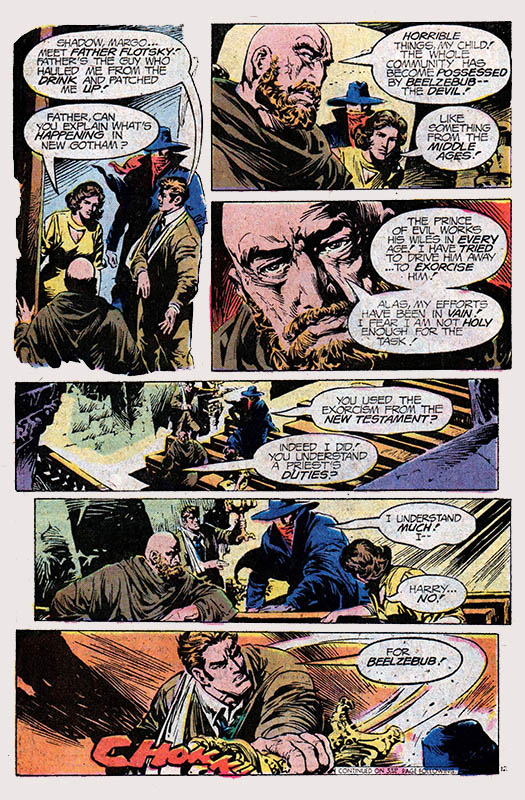
...The Shadow sends Margo Lane and Harry Vincent to New Gotham, a tourist trap town that re-creates life in America as it was 150 year ago.
But, as soon as they arrive, they're attacked and overwhelmed by hooded figures!
Meanwhile, in New York City, The Shadow scours the Russian expatriate community looking for Ivan Zarnovich aka Ivan the Possessed!
Returning to headquarters, He Who Knows What Evil learns Margo and Harry haven't reported in, and flies his autogyro towards New Gotham.
The aircraft was a wise move as the locals destroy the bridge that connects New Gotham to the mainland, while preparing to sacrifice Margo to...Beelzlebub???
The Shadow, of course, arrives in time and frees Margo.
Harry, whom the hooded locals had left for dead, leads them to Father Flotsky, a local priest who's apparently trying to stop (albeit unsuccessfully) Satan's corruption of the townspeople!
As The Shadow and Margo are briefed by the priest, Harry (possessed by Beelzebub) knocks them both unconscious.
The two awaken, bound to ancient dunking stools, which the leader of the locals utilizes...
"The Devil will not be mocked!"
This was E R Cruz's last (of three) issues of The Shadow, as well as being the final issue of the series itself.
(Yes, we've ben running them out of order.)
We previously-ran Cruz's second never-reprinted Shadow story, which featured a crossover guest appearance by fellow pulp hero The Avenger HERE and HERE!

Next Week:
Be Here Monday for the Last, Never-Reprinted, Shadow Story by artist Frank Robbins!
and Visit
HERO HISTORIES
for the first chapter of...
...the last "Maxwell Grant" Shadow novel, set in the spy-filled Swinging Sixties!
It's actually pretty good!
Read and see for yourself!

Support Crime & Punishment!
Visit Amazon and Buy...

Thursday, July 27, 2023

THE SHADOW "Night of the Damned!" Part 1

Does He Who Knows What Evil Lurks face off against agents of the actual Embodiment of Evil?
Only The Shadow knows...and now, you will, too!
To Be Concluded...
TOMORROW
Writer Denny O'Neil and artist ER Cruz put The Shadow in a decidedly-atypical situation since he's rarely caught off-guard and usually at advantage in any conflict!

Please Support Crime & Punishment!
Visit Amazon and Buy...